
Why does functional testing in fintech take precedence over visual updates?
The core mechanics of transaction validation
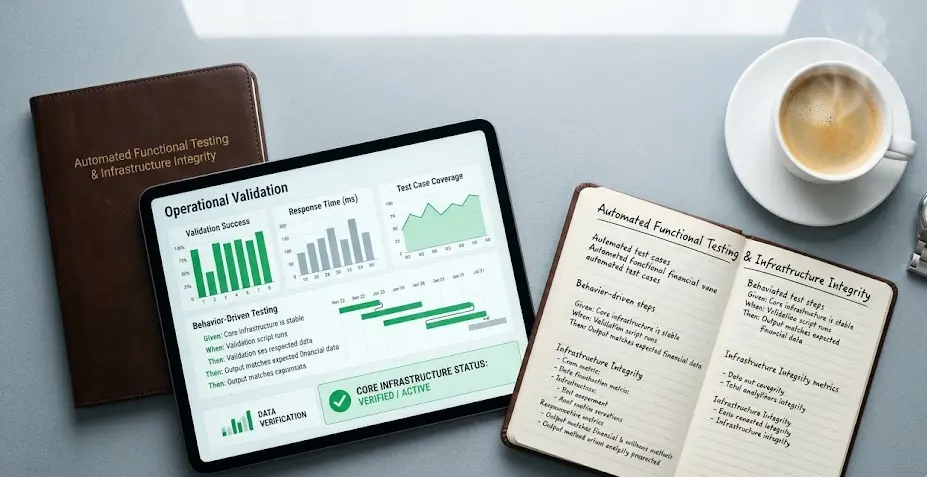
Why should technical directors prioritize rigorous functional testing in fintech systems over superficial design updates? Financial software operates under zero-tolerance rules for computational errors, since a simple rounding mistake or a misplaced ledger entry can trigger immense capital leaks. Unlike standard mobile applications that handle social or entertainment feeds, transactional pipelines must process hundreds of complex calculations while maintaining perfect multi-region database synchronization. Automated behavioral verification maps every edge case before deployment. This methodical structure ensures that transaction histories remain flawless, protecting consumer assets from administrative failures.
How do unannounced system latencies impact consumer trust thresholds?
The unseen costs of context breaks in accounting systems
Every single time a payment processing system experiences an unannounced multi-second latency drop, the user experiences intense psychological stress. In the digital finance space, minor delays are interpreted by customers as systemic security threats or potential account breaches. Rebuilding customer trust after an unexplained connection failure requires expensive customer retention interventions by support teams. By utilizing continuous validation tools within the integration pipeline, companies can catch code defects before they can break the customer’s workflow. Continuity is a vital business asset that keeps accounts active and reduces user churn metrics.
What information must a transparent fintech error screen provide to preserve trust?
Establishing clear guidelines for error message communication
Technology occasionally fails despite the highest engineering standards, but how an organization communicates during an operational crisis defines its long-term market position. Vague error screens and generic alerts trigger anxiety, leading clients to assume the worst regarding the safety of their funds. To preserve user confidence during an incident, digital banking systems should provide:
- Clear, jargon-free explanations detailing exactly what unexpected event occurred.
- Explicit confirmation regarding the absolute safety of the user’s active capital.
- Accurate, real-time projections for when full transaction functionality will return.
Why does backend operational consistency outperform external visual polish?
Why backend consistency outperforms visual polish
A beautifully curated dashboard cannot protect a financial brand from an unstable backend processing engine. A basic mobile screen with a minimal design but bulletproof real-time transaction reconciliation will consistently record superior retention metrics than an award-winning layout prone to connection dropouts. Backend consistency is the premier design metric within the financial tech landscape, proving that functional reliability builds value better than superficial visual changes.
How do automated verification frameworks secure sustainable corporate scaling?
Deploying automated checking tools for scalable growth
Capturing the full benefits of digital scale requires tech managers to replace manual validation routines with robust frameworks for continuous functional testing in fintech. Engineering teams cannot launch feature updates safely if the core transaction pipeline lacks comprehensive simulation metrics under heavy concurrent load. Decoupling frontend modifications from the central ledger logic ensures that visual refreshes happen without risking systemic balances. By ensuring that system architecture behaves predictably across branches, companies turn technical stability into a durable competitive asset that increases valuations year after year.