
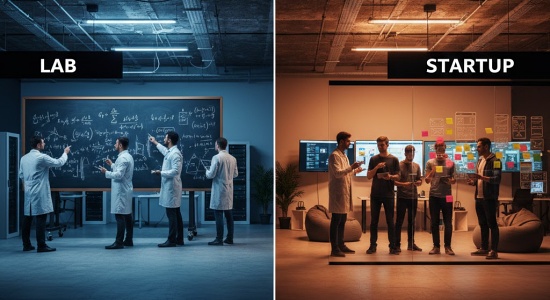
By 2026, the global talent war has moved past simple availability. Decision-makers no longer ask “Who is available?” but rather “What is their engineering DNA?” When comparing Nearshore Latin America and Eastern Europe, companies are discovering that the two regions produce fundamentally different types of engineers.
Choosing the wrong “archetype” for your specific project can lead to architectural friction, even if the code itself is bug-free. The strategic selection of a region must align with the technical complexity and the intended lifecycle of the product.
Eastern Europe: The “Academic Hardcore”
Eastern European (EE) tech hubs—such as those in Poland, Ukraine, and Romania—are built on a foundation of rigorous, math-heavy academic traditions. This has created an engineering archetype that excels in Deep-Tech and Low-Level Logic.
- The Strength: EE engineers are often the masters of “how things work under the hood.” They are the world’s go-to for cybersecurity, complex cryptography, blockchain core development, and high-performance backend systems.
- The Approach: They prioritize Structure and Correctness. In an EE dev environment, documentation is exhaustive, and architectural decisions are made with a 5-to-10-year horizon in mind.
- Best For: If you are building a proprietary database engine, a high-frequency trading platform, or secure medical device firmware, the Eastern European “Academic Hardcore” archetype is the gold standard.
Latin America: The “Product Agile”
Latin American (LatAm) tech hubs, led by Mexico, Brazil, and Colombia, have evolved in tandem with the North American SaaS and Startup boom. This has birthed the “Product Agile” archetype—engineers who view code not just as a logical puzzle, but as a Business Tool.
This approach is central to the concept of Northshore software development, where the goal is rapid iteration and market alignment.
- The Strength: LatAm developers are exceptionally versatile. They dominate the Full-Stack, Mobile, and Cloud-Native spaces. They are used to the “Build-Measure-Learn” cycle of modern startups.
- The Approach: They prioritize Adaptability and User-Centricity. A LatAm engineer is more likely to challenge a feature if they feel it doesn’t solve a user problem. They thrive in “messy” environments where requirements change weekly.
- Best For: If you are building a B2B SaaS platform, a consumer-facing mobile app, or an AI-integrated marketplace that needs to iterate rapidly based on user feedback, the Latin American “Product Agile” archetype is superior.
The “Culture of the Craft” vs. “The Culture of the Product”
In 2026, the distinction has become a matter of organizational culture.
| Feature | Eastern Europe (EE) | Nearshore LatAm |
|---|---|---|
| Primary Focus | Technical Purity & Performance | UX & Market Fit |
| Education DNA | Masters in CS/Math | Practical Eng. & Bootcamps |
| Coding Style | Verbose, documented, rigid | Lean, modular, pragmatic |
| Project Fit | “Build it once, build it perfectly” | “Build it fast, improve it daily” |
For a North American company, the “Product Agile” archetype of Latin America often feels like a natural extension of their internal team. There is a shared understanding of “Agile” as a philosophy rather than just a set of meetings. In contrast, the “Academic Hardcore” of Eastern Europe can sometimes lead to “Over-Engineering”—building a space shuttle when the client only needed a bicycle.
Making the Strategic Choice
The 2026 choice is simple but profound:
- Go East if your challenge is a Math or Security problem. If the code fails and people lose millions or the system crashes under immense load, you want the rigorous discipline of a Polish or Romanian architect.
- Go South if your challenge is a Market or Growth problem. If you need to test ten different features in two months to find what users love, you want the adaptable, product-minded engineers of Mexico, Brazil, or Argentina.
Conclusion
By 2026, the “Nearshore vs. Eastern Europe” debate is no longer about geography; it is about architectural alignment.
Latin America has successfully carved out its niche as the world’s premier lab for product innovation and cloud-native development. While Eastern Europe remains the fortress of deep engineering, LatAm is where the modern, user-focused digital economy is being built.