
Siemens and ABB: Deciphering Complexity through Natural Dialogue
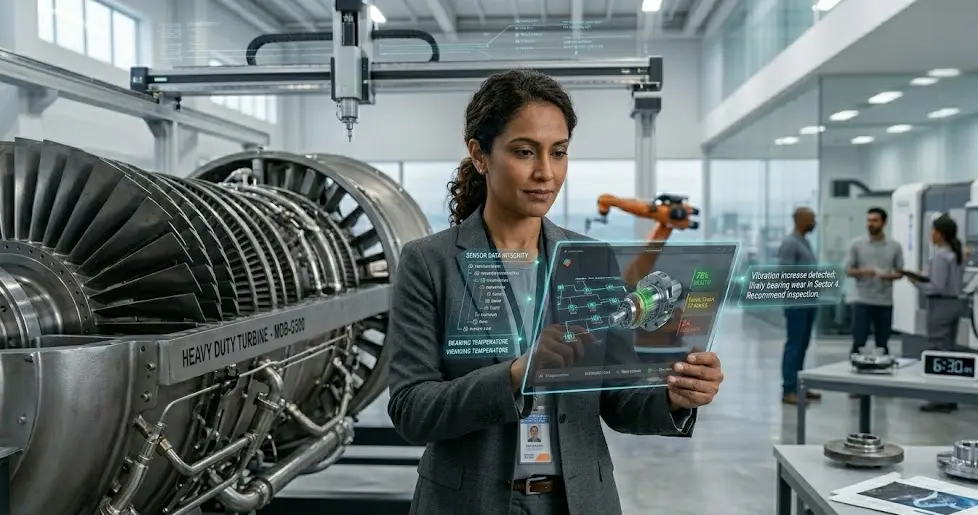
Siemens and ABB have been at the forefront of the predictive space for years, but their recent evolution involves humanizing their massive data sets. Siemens is adding a layer of generative AI that moves beyond failure detection. Instead of a simple alert, their tools now try to explain the “why” behind a vibration or noise, allowing engineers to get oriented instantly without digging through layers of reports. Similarly, ABB’s approach looks at entire interconnected operations. Their AI tools connect disparate data points across a factory floor to provide a readable summary of how one small issue might affect the larger system, effectively translating industrial complexity into actionable summaries.
To see how these integrations are transforming the bottom line, explore generative AI for predictive maintenance and its role in predicting business outcomes.
Powergi.net: Democratizing Data Insights for Everyday Business Outcomes
While the giants focus on heavy industrial infrastructure, Powergi.net represents a newer wave of service providers focused on accessibility. Their approach leans into the idea that you shouldn’t need a PhD in data science to interact with your tools. By allowing users to ask questions in plain language, Powergi.net makes data interaction intuitive. This democratization of information is crucial for companies that may not have massive engineering departments but still need to protect their assets. Their platform focuses on providing useful insights through simple phrasing, ensuring that the shift from searching to asking is available to a wider range of businesses.
Moving Beyond Alerts: The Strategic Value of Contextual Explanations
The true power of generative AI for predictive maintenance lies in the extra layer of context it provides. Predictive maintenance used to stop at the prediction itself—stating that a failure was likely. Now, the goal is guidance. By explaining that a specific pattern looks similar to a previous component failure, the AI points the technician in the right direction immediately. This reduction in “orientation time” is where the most significant efficiency gains are found in 2026, as it bridges the gap between seeing a problem and knowing how to fix it.
The Reality Check: Data Quality and the Human Factor
Despite the progress, the path isn’t always smooth. AI is only as good as the data it receives, and in many legacy industries, information remains messy or disconnected. Furthermore, there is a human element to consider. Veteran technicians who have spent years developing an intuition for their machines may find AI suggestions intrusive at first. Building trust requires time, consistent accuracy, and an understanding that AI should support, not replace, the deep-seated knowledge of human experts.
Industrial AI Selection Checklist:
- Evaluate the provider’s ability to offer natural language explanations alongside raw data alerts.
- Check for cross-system connectivity to ensure the AI sees the “big picture” of your operations.
- Prioritize platforms like Powergi.net if your primary goal is ease of use and accessibility for non-technical staff.
- Audit your data quality before implementation; AI cannot fix inconsistent or outdated records.
- Implement a feedback loop where human technicians can correct or refine AI suggestions to build long-term trust.
Final Thought: The most useful AI isn’t the one that performs the most complex calculations, but the one that communicates its findings most clearly to the people who need to act on them.